
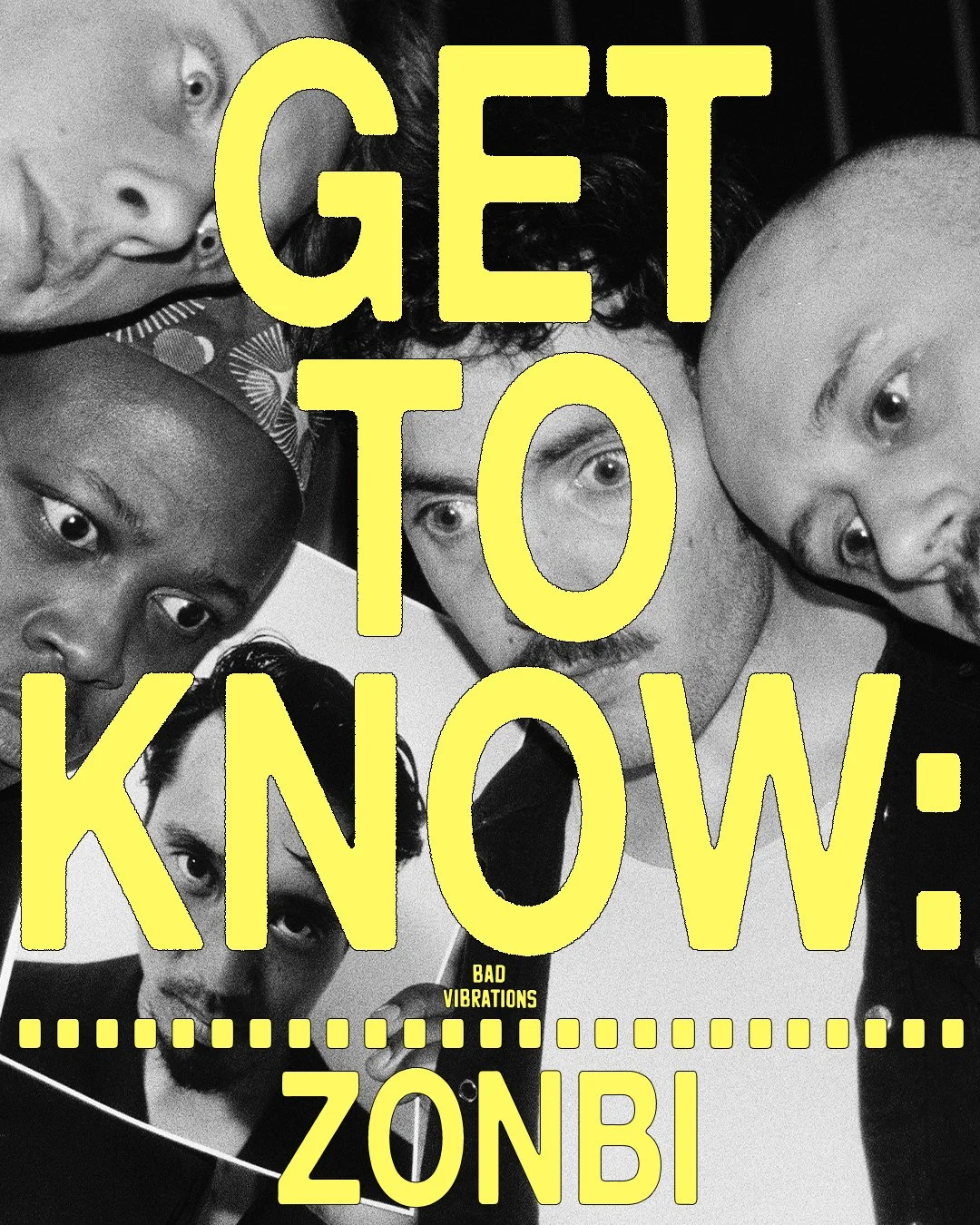
For anyone discovering ZONBI for the first time, how would you describe who you are and the world you’re creating with the project?
ZONBI is an outlet, like every art project should be, we think. And as an outlet for human emotion and stories, it’s inherently chaotic ahah! So to sum it up, I’ll say ZONBI is a Parisian band about disobedience, spirituality, emotional honesty in face of alienation. It blends stories of the modern day estrangement, dispossession of self-determination, and confronts them to what we would call the good ol’ fire resting in our guts. We try to light it. Make it grow.
Your music pulls together punk and post-punk, free jazz and Haitian roots music. How did those different influences first come together?
Those influences primarily came from who we are, what we listen to, it was really direct, which is our objective. It’s really not a big thought process. Maybe it’s because of the nature of those genres ? That they are all rulebreakers in their own way ? That they all are physically and emotionally taxing genres for those who play them ? I think we are trying to draw inspiration from the revendicative spirit in them.
There’s such a raw, almost chaotic energy to the music. How do you translate that into your live shows?
Our live shows are the most fun aspect of what we do. We always try to surprise ourselves, letting space for improvs, chaos, because that’s where the good, the yummy, the gnarly stuff happens. We try not to be too comfortable with our music, we would lose the life we get from the chaotic aspect of it, and we don’t think it’s fun to watch someone play the exact record that you listened on your way to the gig. It’s a funambulist work ethic. It always need some danger.
You released your debut self-titled EP last year. What did you want that record to introduce people to about ZONBI?
The self-titled ZONBI EP wasn’t meant to introduce anything to anyone. I’ll have to explain the birth of the project for that to be clear. ZONBI started when Dimitri (singer/saxophonist of the band) met the japanese artist, Shion Iwata (tenor sax) performing in front of an art center in Paris. Dimitri introduced him to his friends, they had a big jam, became friends, and when Shion had to go back to Japan, they agreed that they had to make a record to celebrate this meeting. Meeting Shion was the starting point of the band, and that first EP is a testimony of that meeting with him, and what it meant to us. We then decided to publish it because we believed that the project could evolve, and that we haven’t had enough of it.
Your lyrics are sung in Creole and draw on ancestry and Haitian history. How important is storytelling and cultural heritage to ZONBI?
For us, singing in Creole isn’t a stylistic choice; it is the only way to tell these stories with sincerity. This language is a part of me (Dimitri) - I grew up with it, and it carries the humor, suffering, and resilience of those who came before us. Haiti’s history is filled with stories that have too often been stifled, distorted, or forgotten. For us, Zonbi is also a way to make these stories heard and to share them loud and clear. The very figure of the zombie stems from this history: it symbolizes bodies and spirits reduced to slavery, as well as anything that refuses to stay buried. Thus, even when the music is raw and chaotic, an underlying story is always present. We want the audience to feel that energy first - even without understanding every word - and then feel compelled to discover where it comes from.
What’s next for ZONBI, and what are you most excited about heading into the next chapter of the band?
We are searching for a more drastic way of expressing. We are eager to explore further again. A new EP is coming in few months, it tends towards this gesture.